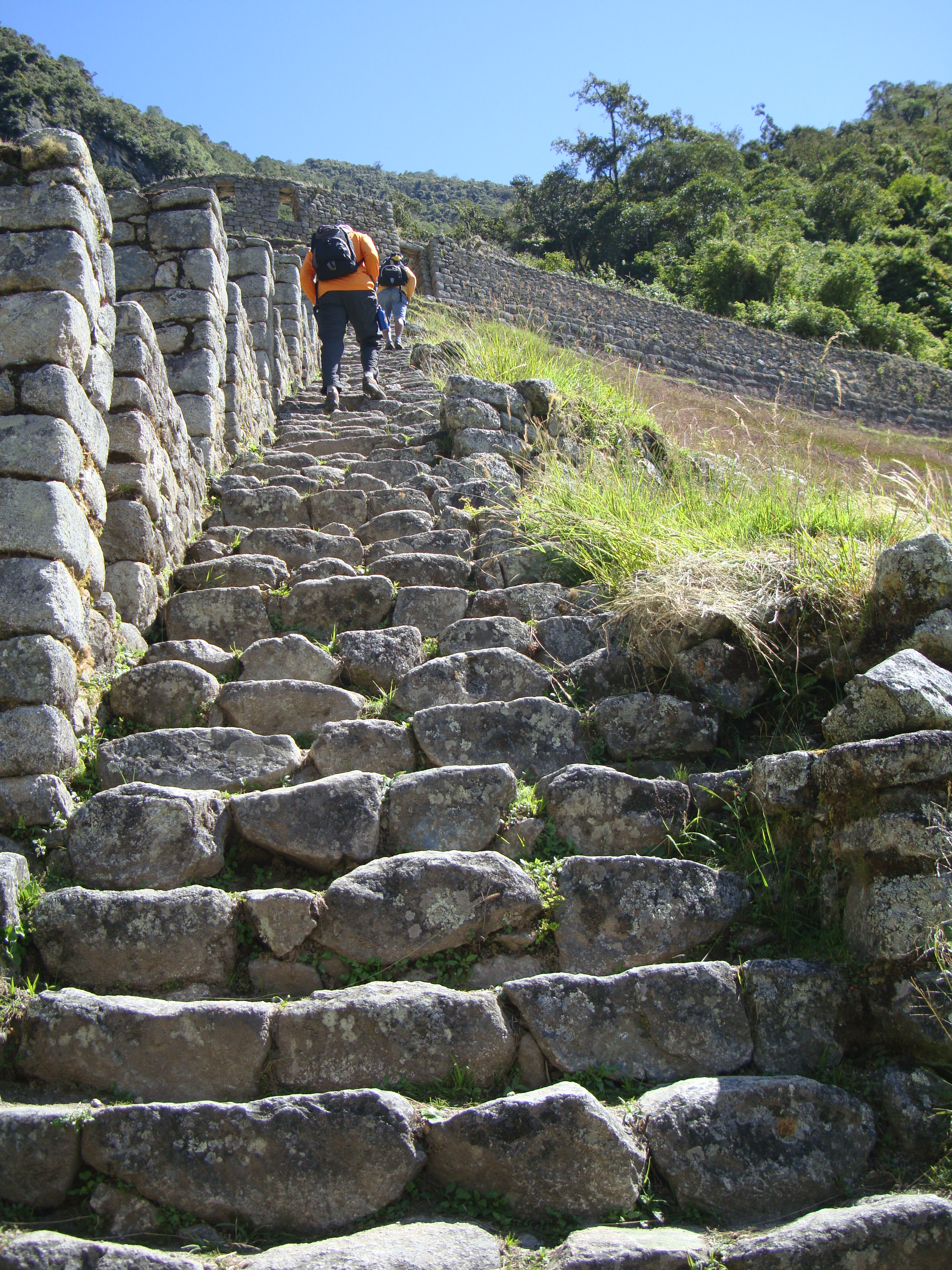
Getting ready to do the Classic Inca Trail, which involves four days of trekking through the Andes Mountains to Machu Picchu, requires a certain level of fitness to enjoy the journey. The Inca Trail covers a distance of 24 miles, and includes over 7,000 feet of cumulative elevation gain, and 6,900 feet of descent. Rumor has it that there are more than 3,000 steps throughout the entire trail. The highest altitude point is at Dead Woman’s Pass at 13,776 feet.
In preparation for my trip to trek the Classic Inca Trail in May, 2012, my training actually began way before I even dreamed that it was possible. Coming into the home stretch for my trip, I have begun my intensive training for the trek four months prior to departure. In all reality, I have been training for this trek over a span of four years of steady hiking. I can now hike 30+ miles per week, with elevation gains of 2,000+ feet in single hike.
Trekking on the Inca Trail challenges your full body and in particular your lower body and core muscles. The more you can train for the trip, the less chance you have of being injured and sore on the trail.
The best way to train for this trek is to HIKE as much as you possibly can. Any opportunity that you can to join a local hiking club will greatly improve your success on traversing the Inca Trail. Training can be done in the gym, on a bike, or running. However, nothing replaces the training for hiking than hiking itself. There is some technique to hiking, in particular a very rocky, and step-filled trail. There are motoring muscles that are used to heave yourself up a steep hill that aren’t really used with these other activities. Also, learning how to manage your footsteps while going over the rocky trail is a skill that is developed.
Balance work is also essential as while you are traversing the rocky trail, there will be countless occasions where strong balance will be your saving grace from face planting onto a rock.
Plan on using hiking poles on the trail – two is preferable, but one is better than none. In particular, you’ll really want these for the descent especially if you have achy knees. You can either bring your poles with you, rent some from your trekking company, or buy one of the many wooden ones available for sale all around the trail. Make sure that your poles have rubber tips as metal tips are not allowed on the trail.
Anything aerobically can most certainly assist you in being able to deal with the altitude. However, Altitude sickness really has nothing to do with your age or fitness level. It has to do with how well your body can cope with the oxygen deficiency. If you do not have an allergy to sulfa drugs, you can use Diamox to help you with altitude sickness symptoms like headaches. For dosages, please consult with your physician. It was suggested to me to take two tablets a day, but to break them in half, and take 1/2 of a tablet four times a day. This way the Diamox stays steady in your system, instead of having strong peaks and valleys. I do get strange tingling sensations in my extremities at random times but it certainly reduces my headaches. It is also thought that Ibuprofen (Advil) and Ginkgo Biloba can assist as well.
Coca tea is also very popular to assist with the altitude. I would brew it and drink it cold like Ice Tea. One thing I found is that the Coca Tea gave me acid reflux, so if you’re sensitive to that sort of thing, plan accordingly. Some people actually chew the Coca leaf. I’m not sure how effective this is as in order to really activate the chemicals to assist you in the Coca leaf, a small piece of a black ash is added. You can purchase Coca very easily either in the San Pedro market in Cuzco, or in the Pisac Market. Another Peruvian herb – Muna is also said to help.
On another note, do heed the advice to not eat any fresh vegetables or fruit that you cannot peel. Your tourist body is not accustomed to the water and environment and is thus sensitive to these differences. Bring along a “Montezuma’s Revenge” kit including electrolytes, Immodium, and Cipro. Finally, make sure you only drink water that has been purified – double check any water bottles that you purchase for an unopened seal.
The following page offers the first month of a training outline to help you get started on your training program for the Inca Trail. I apologize as I intended to show a full four-month training program, but had blown out my knee on a fall on a hike January of this year that completely changed my training program. Now that I’ve graduated from Physical Therapy, I am now working with a Personal trainer for the last 8 weeks prior to my trip. I’ll make sure I’ll include the workout exercises the trainer has me doing so that you can add it to your workout plan.
Feel free to comment or send me a message and I’ll be more than happy to share what I’m doing with you.


 Emily Carter ~ Nature as Art
A dream still on my bucket list – and I am getting older. 🙂 Hope to get there before the body packs up. Well written post.
WOW! That will be quite the journey and one well worth it!
It really was ! You should browse my blog and see the day by day stories of the trek.
I thought my going to the gym 4-5 times a week was enough training and boy, was I wrong. I really should have taken the time to do some hiking training instead. 😛
Oh yes…hiking to train for hiking the Inca Trail is crucial ! There are muscles you never knew existed when hiking up a mountain. 🙂
Excellent advice! Only one of our party made it to the Inca Trail in June (my husband was going to go but my daughter ended up in the hospital in Cuzco the night before – yuck!) but it is an experience of a lifetime, I’m sure!!!! Machu Picchu was more beautiful for me this, my second time because I drank lots of the coca tea and walked slowly.
I love your blog!
Thank you so much Krystiana. So wonderful that you were able to visit Machu Picchu more than once. There is so much to see, and I would love to able to go back again. You thought you walk slowly..you should have seen me!
I’m heading to Peru in May to climb for charity. This is my first ever hike, so your blog was very useful. Any other hints and tips will be greatly appriciated 🙂
Dead Woman’s Pass is at the highest altitude…I can understand that!
WONDERFUL pictures, especially of the stone steps.
Where is “The following page” with the training program? Sorry…new.
Here you go.
http://bellaremyphotography.com/training-program-for-the-inca-trail/month-one-program/
I’m this close to booking my trip! Thanks for the tips.
Thank you for this! I might be doing a trip in May and I’m a little worried about the altitude sickness (I have a delicate constitution for sure, including the sulfa allergy).
There are lots of places to hike in my area but would you recommend any additional training? Also, does it help to hike at higher altitudes in the weeks leading up to the trip?
Hi! I’m a little worried about the altitude sickness. I have a delicate constitution and if it there’s a chance something will make me sick, it usually does. However, I’m in decent shape and live in Southern California so plenty of places to hike and train.
Question: would it help to do high-altitude training in the weeks and/or days leading up to the trip?
Hi LA Lady, The altitude is indeed challenging as one doesn’t know how you react to it until you’re in it. If there are some altitudes available to you close by – by all means get as high as you can to see how you feel. My girlfriend that went also is allergic to Sulfa drugs and instead took Advil and lots of Coca tea. She had a little bit of bleeding in the nose from the altitude, but other than that she was fine.
Are you going to be doing the four-day hike or the one-day hike? If you’re concerned, the one-day hike is a fantastic and fun hike and practically no one is on the trail. You do get to see some ruins along the way as well. You end up at the same point as the four-day trekkers without all of the hard work. Maximum altitude on that hike is just under 9,000 feet.
Any extra time you can spend in Cuzco prior to hiking will help you tremendously. Feel free to ask more questions.
Awesome! I think we’re doing the 4 day hike (my in laws have invited us on this trip and they just finished hiking Nepal and are hungry for more). Acclimation in Cuzco seems like the best idea. I grew up taking trips to Central Oregon and would get nosebleeds at 4,000 feet. Lame.
Ok the In-laws are just mean – here they are all tuned up and ready to go and they’re taking you on a really difficult and intense trek.
The altitude sensitive is not lame, it is what it is. Do know that once you’re on the trail, you’re on the trail. There is no bailing out after the first mile or two. If something happens, a porter will have to carry you out. I’d like to hear how you do after a high altitude visit in your area. We want to keep you safe. 🙂 Feel free to email me at bellaremyphoto@aol.com
Hi
Just had an interesting read of your page.
We are intending to complete the trail in either May or September next year, thanks for the heads up on being fit
We will be celebrating my retirement sand are looking forward to it.
I have recently taken up photography and any tips would be appreciated
Kind regards
Jim
I recommend reserve the inca trail 3 or more months before you trip because there are only 500 permmits available per day. Here http://incatrailmachupicchu.org/ can find more alternatives for the inca trail…
Good Luck!
Amazing post!! I am doing the trail in april next year and have to start prepping now. I am not very good with steps, so lets see!!
You reckon inclined treadmill and using a stepper for exercise will help?
Also wearing knee and ankle supports while hiking?
Dear Ruma, I am thrilled that you’ll be going on the Inca Trail and how I wish I could be with you. Yes, by all means, get ready for all of the thousands of steps that you’ll encounter.
If you have knee issues, by all means, I do suggest knee braces to help you. If you send me a private message at bellaremyphoto@aol.com we can discuss that further. I would suggest using balance warming exercises which include a Bosu (1/2 inflated ball). Near a wall, you stand on one foot on the Bosu, the other off, using just a finger to catch your balance. Stand on each foot for a minute each. If you do this at least twice a week you’ll see a quick difference in your ankle strength, leg strength and overall balance.
The Stepper and Treadmill are certainly helpful and hopefully you’ll also be able to get out and hike as well. Plan on using trekking poles with rubber bottoms on the trail. Hope to hear from you and I’m happy to help.